
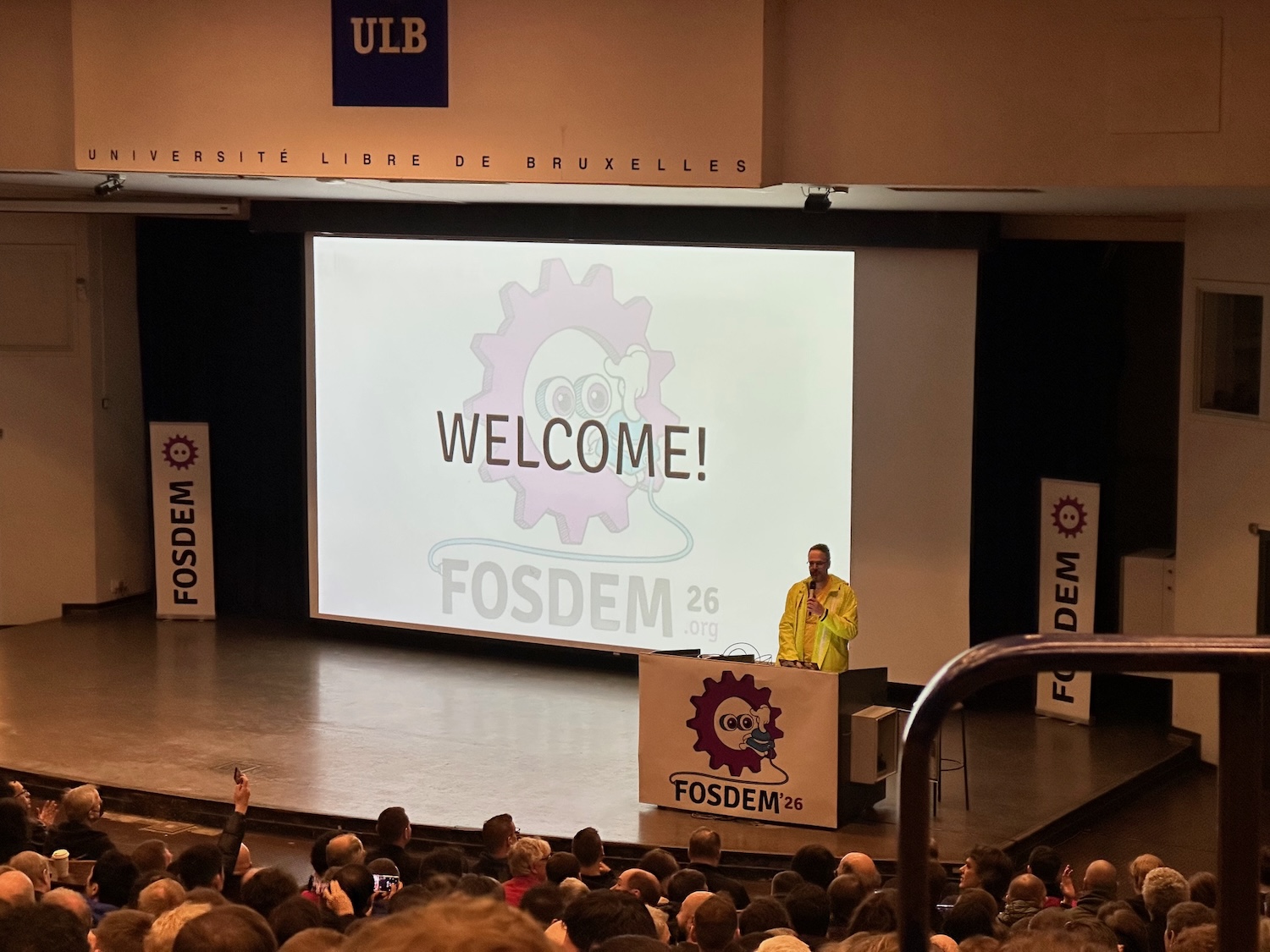
In February 2026, I attended FOSDEM once again in Brussels. Having attended the conference previously, it has become something of a tradition, especially as I often travel with former colleagues who have become good friends and who return year after year.
For me, FOSDEM has always been more than a technology conference. It is an opportunity to stay up to date with emerging technologies, discover new ideas, and engage with a community of curious, open-minded people who are passionate about learning and sharing knowledge.
A Unique Atmosphere
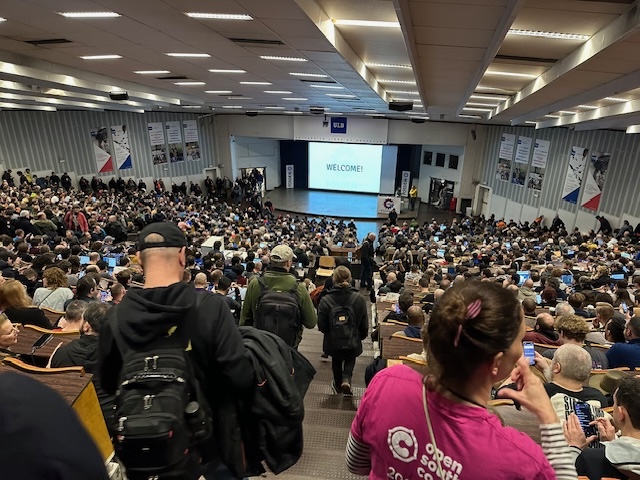
One of the things that makes FOSDEM special is its setting. Hosted at the Université Libre de Bruxelles (ULB), the event has a distinctive university atmosphere that is difficult to find elsewhere.
Growing up in Palermo, my experience of university computing courses was very different, so walking through lecture halls filled with people eager to learn, discuss, challenge ideas, and explore new technologies is always refreshing. There is a genuine sense of curiosity and collaboration that resonates throughout the entire event.
What continues to impress me is the willingness of people to share their knowledge with others. Many speakers present topics outside their day-to-day expertise, stretching themselves to contribute something valuable to the community. That commitment to collective learning is one of the defining characteristics of FOSDEM.
Unlike many commercial conferences, FOSDEM is free to attend. While major technology organisations are present and sponsors help make the event possible, the focus remains firmly on knowledge sharing rather than sales pitches. The result is an environment where conversations feel authentic, open, and community-driven.
The Rise of AI Sovereignty
Across the many sessions, discussions and hallway conversations, one theme stood out above all others: AI sovereignty.
While artificial intelligence continues to evolve at an extraordinary pace, many participants were focused on a fundamental question: who controls the data, the models, and ultimately the outcomes produced by AI systems?
My personal interpretation of AI sovereignty is the ability for users and organisations to retain control over their data and digital assets. As AI services continue to grow, user interactions and data often contribute to the ongoing improvement of models. This creates a shared relationship where users benefit from powerful capabilities while AI providers benefit from the information required to improve their systems.
The open-source community is increasingly exploring how greater transparency, independence and control can be achieved, ensuring that organisations are not entirely dependent on a small number of providers. It was fascinating to see the depth of discussion around these topics and the strong interest in open alternatives.
Technical Highlights
While I attended a wide variety of sessions spanning AI, security, identity management, open-source governance and software supply chain topics, two talks stood out in particular.
The first focused on improving pull requests and making them more effective for maintainers and reviewers. Although seemingly simple, it provided practical insights that many software engineers can immediately apply in their daily work. Clear communication and well-structured pull requests remain essential to successful collaboration, whether contributing to open-source projects or delivering enterprise solutions.
The second was a session on NES dynamic recompilation. From a purely technical perspective, it was fascinating. On a personal level, it brought back memories of my teenage years experimenting with console emulators and exploring how software worked under the hood. Talks like this highlight another important aspect of FOSDEM: people attend not only to advance their careers, but because they genuinely love technology.
Why This Matters for Capgemini
One of my key takeaways from FOSDEM 2026 was the continued strength and vitality of the open-source ecosystem.
The community continues to innovate across areas including artificial intelligence, security, identity, privacy and software development practices. Many of these innovations eventually influence mainstream enterprise technology and client solutions.
For organisations like Capgemini, open-source technologies can provide opportunities to build effective, flexible and cost-efficient solutions while benefiting from the innovation generated by global communities. As always, technology choices should be made carefully and in accordance with client requirements, but FOSDEM reinforced the value of continually evaluating open-source alternatives alongside commercial offerings.
Final Thoughts
If I had to summarise FOSDEM 2026 in one sentence, I would say:
“FOSDEM 2026 demonstrated that while AI is reshaping the technology landscape, the open-source community remains committed to transparency, collaboration, knowledge sharing and keeping innovation accessible to everyone.”
Beyond the technology itself, what I will remember most is the atmosphere: reconnecting with friends, meeting passionate technologists, and spending a weekend surrounded by people who are genuinely excited to learn and share ideas.
In a fast-moving industry, events like FOSDEM are a valuable reminder that innovation is driven not only by technology, but by communities willing to collaborate, challenge assumptions and learn from one another.